Charlie Goldsmith has spent most of the last twenty years in Africa, building schools, then national payroll, payments and education data systems, and now working on humanitarian cargo drones. In South Sudan, the school data system his company built made possible the grants and teacher incentives behind a rise in enrolment from 0.9 million to 2.6 million pupils between 2014 and 2020. Here he reflects on his Kennedy year and the path it opened.
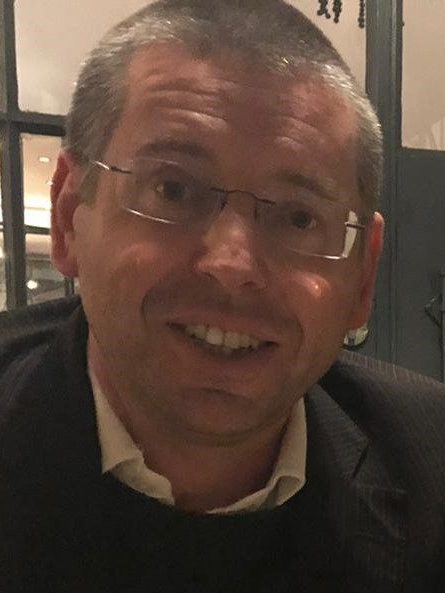
“I live in Lusaka, Zambia, and have been in Africa for most of the last twenty years.
“I was a Kennedy Scholar in 2000–01, straight out of undergraduate, and a Classics undergraduate at that. So the panel were taking a gamble on, presumably, perceived ethos and potential, and previous scholarship-boy hard work. I studied at the Kennedy School and at MIT. I did some global development, some economics and some contemporary African history at the former, and some railway and bus timetabling and logistics at the latter. I also sat quietly and read Ovid’s Metamorphoses.
“I worked in the British Railways for Richard Davies (MIT 1982), briefly as a consultant in the same sector, then went to Sudan (as was). I helped the church there work with church friends in Salisbury to build schools. From that came work setting up a teacher headcount and payroll system, and that turned into work on national payroll and payments systems in various places. I set up a company as a vehicle for that kind of work, which took on various national-scale tasks in low-income and fragile places across Africa.
“Lutheran World Relief of the United States bought that company, now CGA Technologies, in 2019. Since 2022 I’ve been shared between Abyrint A/S, a specialist Norwegian firm, and Windracers, a cargo drones firm. I’ve not flown high in institutional terms, objectively. I am still at country-level implementation in Africa. The merit of my present perch, is that you have knowledge of the particular that the policywallah at base cannot easily attain. You can make concrete judgements, ‘let’s do it like this, which I know to be good, and not like that, which I know to be not so good’, rather than abstractly ‘making a framework’.
“The scholarship meant I knew enough to start to engage sensibly in the fields I cared about working in. For someone without the means or chutzpah to self-finance, or to get internships and so on up the global development learning curve, this was specifically constructive.
“I found America odd then, and odder now. But better to recognise something is different than erroneously imagine it the same. I walked quite some way to and fro each day from Somerville to Harvard, for lack of public transit. I loved the parish church, Christ Church, Cambridge, where I sang and worshipped while I was there, and the chums I learned and worshipped with.
“I hope Trustees past and present, and you, the reader, will feel this work isn’t totally negligible, and, with luck, that I was not a total waste of rations.”


